






- Newssuper Report Tania Kundu Kolkata, 27 March, 2026:
Imagine a morning at a bustling railway station: the whistle of a departing train, the aroma of fresh tea, and the anticipation of a journey. Now, imagine that scene marred by discarded plastic bottles, food wrappers, and waste piling up on the tracks. For years, garbage has been a silent passenger on the Indian Railways—an uninvited guest that doesn’t just look bad but creates a chain reaction of problems. Waste buildup is more than just an eyesore; it is a significant hurdle for smooth operations because garbage on the tracks can choke drainage systems, leading to waterlogging during rains, which can potentially delay trains and cause technical glitches. For passengers, it means unpleasant odors, hygiene risks, and a diminished travel experience that takes away from the joy of travel.
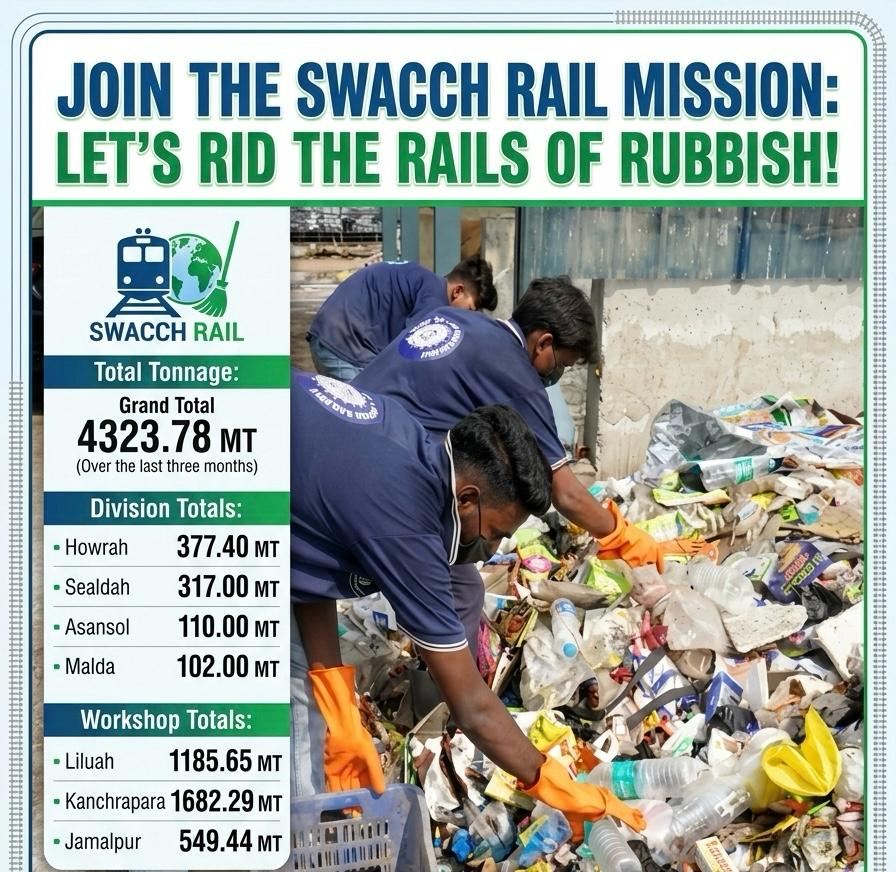
Recognizing that a clean journey is a fundamental right, Eastern Railway has intensified its mission to scrub its divisions and workshops clean. In a major logistical feat over the last three months, the railway has cleared a staggering grand total of 4323.78 Metric Tonnes (MT) of garbage. Every corner of the Eastern Railway network participated in this massive drive, from the busy platforms of the city to the heavy-duty industrial workshops. The data recorded from December 2025 to February 2026 shows a relentless effort across all sectors.The combined efforts of the various divisions and workshops have led to significant results in waste management over this three-month period. Specifically, the Howrah division cleared a total of 377.40 MT, while the Sealdah division accounted for 317.00 MT of garbage. Asansol division successfully removed 110.00 MT, and Malda division contributed 102.00 MT to the total. The industrial workshops played a massive role as well, with the Liluah workshop clearing 1185.65 MT, the Kanchrapara workshop removing a substantial 1682.29 MT, and the Jamalpur workshop managing 549.44 MT, all culminating in the impressive grand total of 4323.78 MT.
Eastern Railway is taking every initiative to ensure cleanliness, from mechanized cleaning of coaches to regular track monitoring. However, the fight against filth cannot be won by the authorities alone, as most of the waste found on railway premises comes from daily littering—discarded items that belong in a bin but end up on the floor. Shri Milind Deouskar, General Manager of Eastern Railway, stated to the passengers that Indian Railway is their property and they should take the initiative to help maintain this cleanliness. Passengers are also reminded that keeping the railway clean is not just a civic duty but a legal requirement. Under the Railways Act, 1989, specifically Section 145(b) and Section 154, any person found littering or creating a nuisance on railway premises is committing a crime and can be fined or prosecuted.